When it comes to explaining human behavior, just about every answer combines some elements from the categories conveniently labeled as "nature" and "nurture."
In this context, nature is a category that includes all biological, and more specifically genetic causes for human behavior. You might say that these are "internal" explanations for human behavior.
Nurture is a category that includes all of the environmental factors that explain human behavior. This includes the physical environment, such as the climate and topography where someone might live, as well as the social environment, such as the economic and political systems in place where a person lives.
People tend to try to get a lot of mileage out of explanations appealing to social factors. Of course, a lot of human behavior is explained by social factors. However, this cannot be the ultimate explanation of all human behavior. It's plausible to think that human beings existed before social systems existed, since social systems are human constructs.
So what were people like before the advent of society? This question is of interest to many people, including myself. A lot of people wonder if human beings are inherently good or evil, or if they're inherently selfish or altruistic. Knowing what human beings were like before they organized into social groups may be illuminating in this respect.
How do we know what they were like? Well, we'll never know for sure. If you identify as part of some religious tradition, then you probably some kind of origin story that's supposed to explain mankind's initial state.
Let's set those aside for now and explore non-religious accounts. From, the general consensus regarding the origins of human beings is that they are the products of a long evolutionary process. If we accept that, then we need to piece together a story about how human beings came to be what they are now.
We can infer that at least some behavior of human beings is explained as a result of genetic inheritance. So, we can investigate the behavior of other primates or evolutionary ancestors to get an idea of what human beings were getting passed down to them.
That's one piece of the puzzle. From here, the key is to find roughly where human beings began to abide by some,kind of social contract, i.e. when they began to set aside immediate personal wants in favor of gains had by cooperation. Around here is where we can start asking questions about the initial formation of social groups. For instance, it is conventional wisdom to think that early social groups were hunters and gatherers. How did they behave in those groups? How were responsibilities delegated, and why? For instance, it is common to think that the men were the hunters and the women were the gatherers. Was this actually the case? If yes, then why? Did it have to do with physiological differences?
Showing posts with label Anthropology. Show all posts
Showing posts with label Anthropology. Show all posts
Sunday, October 4, 2015

Saturday, September 19, 2015
Humans and other animals
There's the familiar debate about the relationship between human beings and other life forms on this planet. In particular, people wonder about the difference between human beings and everything else. What does this difference amount to?
Generally speaking, there are two types of differences: differences of degree, and differences of kind.
Differences of degree occur when you have two things that belong to some relevant category, but differ in magnitude with respect to some variable shared by both things.
For example, a pin prick and a migraine headache are similar in that they are both types of pain. However, they differ with respect to the intensity of the pain.
Differences in kind occur when you have two things that don't both belong to the same relevant category. For example apples and rocks differ in kind if the relevant category is fruit.
Having set this up, how do we describe the difference between humans and other life forms? Is the difference primarily of degree or of kind?
Most everyone agrees that humans share a lot with other animals. Humans are carbon based life forms that are sustained via air, water, food. Human are born, reproduce, and die. Furthermore, humans share a lot with mammals. Humans are warm blooded, have body hair, reproduce sexually and via birth.
Some, however, go further and say that although there are lots of similarities between humans and other animals, humans still differ in kind. What does this difference amount to?
Traditionally this difference amounted to something non-physical, like a soul or a spirit. Human beings are somehow made in the image of God, whereas other animals are not. This difference is significant in that it is normative, rather than merely descriptive. According to many religious traditions, human beings are different in a way that makes them "higher" or "better" than other life forms on earth.
Nowadays there are more people who don't affiliate with a particular religious tradition. Among these, many reject the idea that there is some non-physical aspect of humanity that separates it from the rest of life on Earth.
Suppose that we accept the claim that there is no difference in kind between humans and non-human life. There's an issue that we have to deal with. We observe lots of things that humans do that other animals either don't or can't do. Here's a sample list.
Advanced mathematics
Poetry
Moral reasoning
Philosophy
Classical music
Abstract art
Religion
Travel to outer space
Engage in nuclear warfare
Make iPhones
Form democratic governments
What explains the fact that humans do these things and other animals don't?
One route is to say that the difference between humans and other animals is that of degree. Animals can communicate, cooperate, and build stuff. They just can't write poetry and build skyscrapers. Perhaps the difference between humans and animals is more like the difference between an adult human and an infant.
Explanation by difference of degree is kind of satisfying, but not wholly. First, the gap in intellectual ability between humans and whoever's in second place (gorillas, chimpanzees, dolphins, etc) seems incredibly vast. Why are humans so far ahead of everything else?
Second, we don't see any other species doing anything remotely close to what humans are doing. Why is it that just humans are the ones that figured out how to get to the moon? Why haven't other species developed in similar ways?
Friday, September 18, 2015
Art across time and space
Check out these pictures.

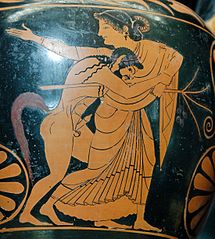

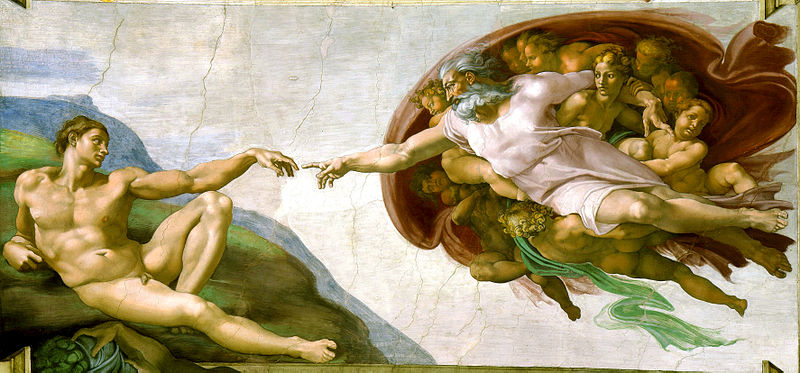
The first is from the Lascaux Cave in France, and is estimated to be about 17,300 years old. The second was painted on a jar in Greece around 520 BC. The third was made in Italy in 1338. The fourth was also made in Italy in 1511. Why do they all look so different? Compare these to the following:
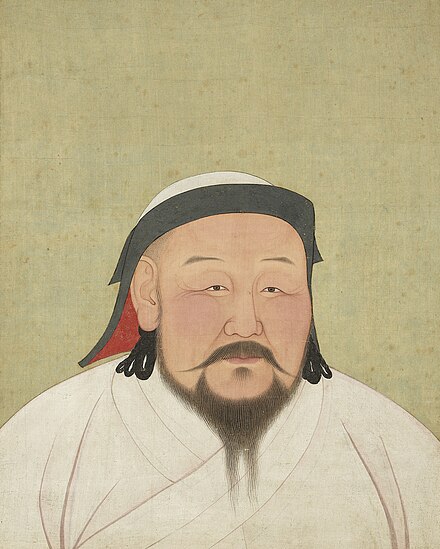
From_Bijin-ga_(Pictures_of_Beautiful_Women)%2C_published_by_Tsutaya_Juzaburo_-_Google_Art_Project.jpg/440px-thumbnail.jpg)
The first was painted in China in 1294. The second was painted in Japan in 1793. These paintings look really different from the European paintings shown above. Why?
I'm assuming that one goal of art is representation. None of subjects in any of these paintings really look anything like the people that you see directly with your own eyes. Why is that? Are these depictions supposed to convey something more than mere representation? What else is included?

The first is from the Lascaux Cave in France, and is estimated to be about 17,300 years old. The second was painted on a jar in Greece around 520 BC. The third was made in Italy in 1338. The fourth was also made in Italy in 1511. Why do they all look so different? Compare these to the following:
I'm assuming that one goal of art is representation. None of subjects in any of these paintings really look anything like the people that you see directly with your own eyes. Why is that? Are these depictions supposed to convey something more than mere representation? What else is included?