Monday, December 28, 2015

Religion and Ideology in the Star Wars Universe

In the Star Wars universe there seem to be two main political bodies: The Republic/Rebellion and the Empire.  There are also two main religious groups: The Jedi and the Sith.  Throughout the movie series and the extended universe, there is some sort of official connection between the Jedi and the Republic and between the Sith and the Empire.  The Jedi are recognized as serving some kind of advisory, diplomatic, and military role in the Republic.  The Sith play various authoritative roles in the Empire, with the chain of command going up to the top Sith, i.e. the Emperor.  I thought it might be interesting to explore the connections between these political and religious groups, and examine whether there were any necessary connections between the ideological and “theological” views held by the various groups.

First, let’s start with the religions.  Both the Jedi and Sith believe in the existence of the Force.  It’s not clear what exactly the Force is.  We can try to come to some general account be look at particular cases of the Force in action.  We see throughout the franchise people being able to telekinetically manipulate objects via the Force.  So, the Force is some part of reality that allows individual to act on physical objects at a distance.  This action usually amounts to moving stuff around, but can also include applying a certain amount of force to an object, as when Darth Vader strangles an Empire officer from some distance away.  So the Force allows individuals to act on physical objects at a distance.  How complex that action can be isn’t clear.  We see lots of scenes of people throwing rocks around.  Can people do more?  Can Yoda play the piano at a distance?

We also note that the Force is somehow able to sustain life after death.  We see in the movies the ghost of Obi Wan Kenobi conversing with Luke Skywalker.  As is conventional of most ghosts, ghosts like Obi Wan are incorporeal, but still physical entities.  While they don’t possess a physical body, and are thus probably intangible, they are still visible and audible.  If they were truly non-physical entities, then they wouldn’t be detectable by any sense. 

So far, what we seem to have is an entity of some sort that adds another layer to the physical universe.  It’s similar to the idea of Chi in ancient Chinese medicine.  Chi is supposed to be a kind of energy that flows through the body over and above the operation of other physiological systems, like the circulatory or the nervous system.  In the same way, the Force is a kind of energy that exists in the universe over and above the physical forces that I’m assuming are already in place, i.e. gravity, electromagnetism, nuclear forces, etc. 

What’s particularly relevant is that there is a distinction between the “light side” and the “dark side” of the Force.  Again, it isn’t exactly clear what this distinction is supposed to amount to.  In the franchise, light and dark side seem to be value laden terms.  However, the Force itself seems to be a value-neutral entity.  Calling the Force itself “light” or “dark” seems similar to calling gravity “good” or “evil.”  So it seems that it’s not the Force itself that is light or dark, but rather the ends to which it is employed that is either light or dark. (Some think that the Force isn’t value neutral in that has the power to benefit or to corrupt, but I think that these effects are the result of amplification.  The Force further corrupts those who are corrupt to begin with.)  Roughly put, the light side of the Force is the Force that is used to further ends like creation, order, and harmony.  The dark side of the Force is the Force that is used to promote ends like self-aggrandizement, destruction, and subjugation. 

If the light and dark side of the Force are understood as the sorts of values that the Force is used to promote, then the Jedi and Sith Orders can be understood as a groups that have more or less the same metaphysical beliefs, but differ with respect to their moral outlooks.  The Jedi Order is probably most similar to Buddhism.  Here is the Jedi Code:
There is no emotion, there is peace.
There is no ignorance, there is knowledge.
There is no passion, there is serenity.
There is no chaos, there is harmony.
There is no death, there is the Force.
Compare this with the Four Noble Truths of Buddhism:
1.       The Truth of Dukkha is that all conditional phenomena and experiences are not ultimately satisfying;
2.       The Truth of the Origin of Dukkha is that craving for and clinging to what is pleasurable and aversion to what is not pleasurable result in becoming, rebirth, dissatisfaction, and redeath;
3.       The Truth of the Cessation of Dukkha is that putting an end to this craving and clinging also means that rebirth, dissatisfaction, and redeath can no longer arise;
4.       The Truth of the Path Of Liberation from Dukkha is that by following the Noble Eightfold Path—namely, behaving decently, cultivating discipline, and practicing mindfulness and meditation—an end can be put to craving, to clinging, to becoming, to rebirth, to dissatisfaction, and to redeath.
We can see in both cases an emphasis against personal desires and emotions.  The idea in general seems to be that the Jedi Order adopts a moral view that de-emphasizes the self and instead promotes a sense of harmony and interconnectedness with all things.  In this case, what is moral is what promotes this harmony.

Let’s move on to the Sith Order.  While the Jedi Order might resemble Buddhism, the Sith Order seems to resemble most a sort of Social Darwinism.  Social Darwinism is a moral theory that makes normative claims out of Darwin’s theory of natural selection.  The theory of natural selection observes that the sorts of physical traits and behavior that persist from generation to generation among biological species are those that most increase the likelihood of a species’ survival and reproduction.  This is merely a descriptive claim.  It describes what we observe when we look out at the natural world.  Social Darwinism transforms this description into something normative.  What a species should do is cultivate those traits and behavior that increase the likelihood of its survival and reproduction.  The slogan “Might makes right” is often associated with Social Darwinism.  The strongest (or fittest) survive, and according to Social Darwinism, they should survive.

The theory of Social Darwinism fits in nicely with what we observe in the Sith Order.  Consider the Sith Code below:
Peace is a lie, there is only passion.
Through passion, I gain strength.
Through strength, I gain power.
Through power, I gain victory.
Through victory, my chains are broken.
The Force shall free me.
A code like this comes as no surprise if we assume that the Sith adhere to a “Might makes right” principle.  

So, let me sum up what I’ve said about the Jedi and the Sith.  The Jedi, similar to Buddhists, preach a loss of the individual self and subsuming one’s self into the Force, i.e. being one with the Force.  The Sith, like Social Darwinists, preach an exaltation of the self and of individual survival.  They preach the use of the Force as a tool to gain power and control.

Okay, now that we've covered the religious groups, let's move on to the political ideologies found in the Star Wars universe.  The two main political bodies found in Star Wars are the Republic/Rebellion and the Empire.  These are more familiar and thus easier to describe.

The term "empire" describes a type of political body, whereas "republic" describes a form of governance.  An empire is a political body that results when one state assumes control of other states, usually either by war or by colonization (Think Roman, Mongol, or British empires).  This is opposed to a federation.  A federation is a political body where each member state has voluntary agreed to join the larger political body (Think United States, United Nations, or European Union).  I'm assuming that the Republic in Star Wars is a federation.

A republic is a form of governance.  In a republic, political decision are made collaboratively by individuals who serve as representatives of their constituencies.  This is how the U.S. government works, with congresspersons making decisions on behalf of the rest of the citizenry.  This contrasts with autocratic forms of government, where one person has absolute political power and thus makes all political decisions.  Examples include Saddam Hussein in Iraq, Kim Jung Un in North Korea, etc.   

So, the Empire is an autocratic empire, whereas the Republic is a republic federation.  That's fairly straightforward.  Now let's examine the relationship between the religion and politics of Star Wars.  We find that the Jedi are associated with the Republic, whereas the Sith are connected to the Empire.  As far as I know, the Jedi serve primarily in military, diplomatic, and advisory roles.   Within the Empire, it seems that Sith take on roles of political and military leadership.  Here's the main question.  Is there any necessary connection between the political ideology of one group and the theology of the other?  Do Jedi have to be Republic?  Do Sith have to be Empire? 

It might seem natural for the groups to align this way.  The Sith celebrate the will to power, and this seems to fit in nicely with a form of government in which an individual rises to the top of the political ladder by virtue of his or her expression of power.  Similarly, Jedi theology and Republic ideology seem suited for each other.  The Jedi preach the denial of individuality in favor of subsuming into a greater metaphysical whole.  This is very compatible with a political ideology where consensus trumps individual wishes. 

Even though it seems natural for the groups to be aligned in the way, it need not necessarily be the case.  We can imagine a world in which a Republic-like nation is aligned with a Sith-like group, and where something like an Empire is allied with Jedis.   For the latter, we can look at the history of Asia.  Asia is an area where the predominant religions are Buddhism and Hinduism.  I argued before that Jedi though is very similar to Buddhist thought (I would also argue that it is similar to Hindu thought in that Hinduism emphasizes the subsuming of the individual (atman) to a greater whole (brahman).)  However, the history of Asia shows that empires and autocratic forms of government were more or less the norm until the 20th century.

Finding real life examples of Republic style government aligned with Sith-like groups is more controversial.  However, it's not hard to imagine.  All we have to do is think of a hyper-capitalist nation, i.e. one where the market determines just about everything and there is little to no government intervention.  The government in this scenario still plays some political role.  Typically such minimal states are still in control of military and foreign policy decisions.  However, the de facto leaders of such a society would be those that wield economic power, and these individuals will likely be highly influential in political deliberations.  Some might argue that the United States is moving in this direction.


So, hopefully this little exercise helps us to understand the social and cultural backdrop of the Star Wars universe.  This helps to add a layer of moral complexity.  Since Sith and Empire are not necessarily connected, one group can be villified while the other not.  Likewise, one can morally approve of the Republic ideology while disapproving of Jedi theology.  This allows for a more complex weave of relationships within the Star Wars universe.

Sunday, October 4, 2015

The Original State of Man

When it comes to explaining human behavior, just about every answer combines some elements from the categories conveniently labeled as "nature" and "nurture."

In this context, nature is a category that includes all biological, and more specifically genetic causes for human behavior.  You might say that these are "internal" explanations for human behavior.

Nurture is a category that includes all of the environmental factors that explain human behavior.  This includes the physical environment, such as the climate and topography where someone might live, as well as the social environment, such as the economic and political systems in place where a person lives.

People tend to try to get a lot of mileage out of explanations appealing to social factors.  Of course, a lot of human behavior is explained by social factors.  However, this cannot be the ultimate explanation of all human behavior.  It's plausible to think that human beings existed before social systems existed, since social systems are human constructs.

So what were people like before the advent of society?  This question is of interest to many people, including myself.  A lot of people wonder if human beings are inherently good or evil, or if they're inherently selfish or altruistic.  Knowing what human beings were like before they organized into social groups may be illuminating in this respect.

How do we know what they were like?  Well, we'll never know for sure.  If you identify as part of some religious tradition, then you probably some kind of origin story that's supposed to explain mankind's initial state.

Let's set those aside for now and explore non-religious accounts.  From, the general consensus regarding the origins of human beings is that they are the products of a long evolutionary process.  If we accept that, then we need to piece together a story about how human beings came to be what they are now.

We can infer that at least some behavior of human beings is explained as a result of genetic inheritance.  So, we can investigate the behavior of other primates or evolutionary ancestors to get an idea of what human beings were getting passed down to them.

That's one piece of the puzzle.  From here, the key is to find roughly where human beings began to abide by some,kind of social contract, i.e. when they began to set aside immediate personal wants in favor of gains had by cooperation.  Around here is where we can start asking questions about the initial formation of social groups.  For instance, it is conventional wisdom to think that early social groups were hunters and gatherers.  How did they behave in those groups?  How were responsibilities delegated, and why?  For instance, it is common to think that the men were the hunters and the women were the gatherers.  Was this actually the case?  If yes, then why?  Did it have to do with physiological differences?

Saturday, October 3, 2015

Ethical relativism and high stakes conflict

Here's a thought experiment that I sometimes give to my students if I'm teaching ethics.

Suppose that you have a fundamental moral disagreement with someone very close to you, say a wife or husband.  The moral disagreement is very high stakes, i.e. it's extremely important to both parties.  Let's also suppose that the disagreement plays out in a situation where the outcome either favors one side or the other (so, not both, not neither).

Here's an example that I use to make things more concrete.

Suppose that you and your partner have a child that, because of some terrible circumstance, is now currently in a persistent vegetative state.  The probability that the child recovers is very low.  The two of disagree as to whether the child's life should be terminated.  One of you wants to terminate, and thinks that it's morally permissible.  The other thinks that it isn't morally permissible, and does not want to terminate the child's life.

Obviously this decision would matter, and the result will favor one individual, and not the other.

Suppose that you find yourself in a situation like this, and suppose also that you're an ethical relativist.  How are you going to resolve this situation?

It seems that a situation like this will be resolved only through conflict, manipulation, or brute force.

Why is this?

Disagreements are resolved by appeal to some third party information or principle that all disagreeing parties recognize as authoritative.  If Joe and I disagree about the score of last night's game, and if we both recognize espn.com as an authority, we can resolve our disagreement by checking the website.

But, if you're a relativist, and you're in a moral disagreement, what can you appeal to in order to resolve the disagreement?  If you're a relativist of the subjectivist variety, then only authority presiding over moral is your own beliefs.

People don't think that relativism is a problem because they can ignore a lot of moral disagreement.  All you need to do is hang out with like minded people and keep everyone else at arm's length.  At that point, it's easy to be "tolerant" and to "agree to disagree."

Things aren't always so easy.  Perhaps it is easy for individuals to avoid disagreement, but it becomes increasingly difficult for ethically diverse groups living in the same space to avoid moral disagreements.  What are you going to do, then?

Consider the civil rights movement of the 1960s.  You had two groups living in the same space that disagreed about how one of those groups should be treated.  This disagreement mattered, and you couldn't just walk away from it.  What are you going to do?  If you're a relativist, you can't try to appeal to some greater moral principle to resolve the disagreement.  This was the approach that Martin Luther King, Jr. took.  This conciliatory approach requires some form of ethical objectivism, and of course King was no relativist about ethics.

So, what do you do if you're not an objectivist about morals?  You fight until you either win or die, I suppose.

Friday, October 2, 2015

Analyzing Teaching

I've been teaching at the college level for almost nine years.  This is the longest I've held down any kind of job.  Among all of the jobs that I've had, most of which are in retail, this is by far the job that I enjoy the most.  I feel a bit anxious as it may come to an end as I complete graduate school.  Getting a job as a philosophy professor is not all that different from trying to get drafted to a professional sports team as a collegiate athlete.

Anyways, I have a lot of interest in teaching, and have put some amount of thought into it.  I figure I'd lay out some of thoughts here in the form of an analysis.

So what exactly is teaching?  Let's start at the most general level.  First, there is the descriptive/normative distinction.  What is it that teachers actually do, and what should they do?  I'll start with the first.

Anytime you interact with someone, and the goal of that interaction is to impart knowledge on that individual, you are teaching.  Knowledge in this case could be a "knowing that" kind of knowledge, in which you are conveying some amount of information, or it could be a "knowing how" kind of knowledge, where you are trying to impart some sort of skill or ability.

The "knowing that" and "knowing how" distinction is important, as we shall see below.

The rough definition given above should be good enough for this little essay.  There might be some borderline cases that don't fit the definition, but I don't think we should be worried about them.

If that is what teaching is.  Then what should good teaching look like?  This depends on the context, as teaching occurs in a variety of situations.

The context that is relevant here is institutionalized teaching, i.e. the kind of teaching that you see in elementary, middle, high schools, and in college.  What are teachers supposed to do in these contexts.  What are they supposed to convey?

The conventional thought regarding institutionalized teaching is that it's all about the conveyance of "knowing that" knowledge.  Teachers are tasked with transferring information. It doesn't take long to realize that this view is incomplete.  It is true that part of what teachers do is transfer a body of information, but surely teaching from kindergarten through college is more than that.

Let's look at it from the other end.  What is the point of going to school as a student?  What is the goal or purpose?  The answer is not so clear cut, as there are probably several goals.  Two goals that are prominent in a liberal democratic society like the United States are political and economic in nature.  The political goal of education is to produce effective participants in the democratic process.  The democratic goal of education is to produce individuals who effectively contribute to a more or less capitalist economic system.

What does it mean to be an effective participant in the democratic process?  It probably means being able to make informed decisions about public policies and, in the case of our government, to be able to choose an individual that best represents those informed decisions in local, state, or federal government.

Capitalist systems are usually about growth.  So, to effectively contribute to a capitalist system is to contribute to the system's growth.  How society grows economically will be a function of various factors, which can include manufacturing, information, service, finance, etc.

So, given that those are the goals of an American student, education is recognized as a means to that end.  Thus, what teaching is supposed to be at the institutional level is the imparting of knowledge (both knowing that and knowing how) required for the student to meet both goals.

Of course this is still an incomplete picture of what teaching in a school setting is all about, but it's a start.

Monday, September 21, 2015

Freedom, Democracy, and Bad Faith

Most people in Western liberal societies think that democracy is a good thing, especially when compared to the alternatives.  People generally like to be self-determining, and democracy seems to be the governmental structure that is most conducive to these aims, as opposed to various forms of totalitarianism.

This is all well and good.  I'm a fan of democracy myself.  However, there seems to be a sense in which people take democracy for granted.  They just assume that it's a form of government that will run by itself and steer us toward the most optimal state of affairs.  It's similar to a laissez-faire perspective on the free market.

This attitude is mistaken.  Democracy is designed to execute the will of the people.  How well it achieves the best ends for society will depend on the moral and intellectual quality of the citizens participating in the system.

This is the part that many people take for granted.  They, either explicitly or implicitly, shirk their responsibilities as citizens.  Such responsibilities include more than just going out to vote and paying your taxes.  The responsibility of a good citizen also includes being the type of individual that is capable of making well informed and well reasoned judgments, and thus also includes the responsibility of training to become that type of individual.

Without this ability to think independently and to participate in rational discourse, democracy fails and becomes a more subtle form of totalitarianism.

In totalitarian forms of government, either one or a some group of individuals coerce the citizens to behave in some way.  Usually the level of coercion, and the extent of activities to which it is applied, is seen as way beyond acceptable.  People like to think that they have control over their own lives, and not being explicitly coerced into behaving a certain seems sufficient for having that control.

However, there are at least two ways for someone to not be in control of their lives.  There's the explicit, gun to your head type of coercion.  However, there is a sneakier to get someone to do what you want, and that's through various forms of psychological manipulation.

Someone who shirks their responsibility as a citizen and fails to think critically about political issues becomes more susceptible to various forms of psychological manipulation.  In being psychologically manipulated, they lose control over their lives and are no longer expressing their own will, but rather expressing the will of those doing the manipulating.

The sad thing is that those who being manipulated don't know that they are being manipulated.  They still believe that they are in complete control over their lives.  There's a term for this kind of phenomena from Jean Paul Sartre called "bad faith" (also translated as self deception).  Bad faith occurs when individuals fail to see what is actually true about themselves and instead act on false beliefs about themselves.

Members of democratic societies who fail to participate in rational discourse or deliberation act in bad faith.  The believe themselves to be free citizens, when they are likely to be subject to manipulation.  In a significant sense, they are no longer really free.


Saturday, September 19, 2015

Humans and other animals

There's the familiar debate about the relationship between human beings and other life forms on this planet.  In particular, people wonder about the difference between human beings and everything else.  What does this difference amount to?

Generally speaking, there are two types of differences: differences of degree, and differences of kind.

Differences of degree occur when you have two things that belong to some relevant category, but differ in magnitude with respect to some variable shared by both things.

For example, a pin prick and a migraine headache are similar in that they are both types of pain.  However, they differ with respect to the intensity of the pain.

Differences in kind occur when you have two things that don't both belong to the same relevant category.  For example apples and rocks differ in kind if the relevant category is fruit.

Having set this up, how do we describe the difference between humans and other life forms?  Is the difference primarily of degree or of kind?

Most everyone agrees that humans share a lot with other animals.  Humans are carbon based life forms that are sustained via air, water, food.  Human are born, reproduce, and die.  Furthermore, humans share a lot with mammals.  Humans are warm blooded, have body hair, reproduce sexually and via birth.

Some, however, go further and say that although there are lots of similarities between humans and other animals, humans still differ in kind.  What does this difference amount to?

Traditionally this difference amounted to something non-physical, like a soul or a spirit.  Human beings are somehow made in the image of God, whereas other animals are not.  This difference is significant in that it is normative, rather than merely descriptive.  According to many religious traditions, human beings are different in a way that makes them "higher" or "better" than other life forms on earth.

Nowadays there are more people who don't affiliate with a particular religious tradition.  Among these, many reject the idea that there is some non-physical aspect of humanity that separates it from the rest of life on Earth.  

Suppose that we accept the claim that there is no difference in kind between humans and non-human life.  There's an issue that we have to deal with.  We observe lots of things that humans do that other animals either don't or can't do.  Here's a sample list.

Advanced mathematics
Poetry
Moral reasoning
Philosophy
Classical music
Abstract art
Religion
Travel to outer space
Engage in nuclear warfare
Make iPhones
Form democratic governments

What explains the fact that humans do these things and other animals don't?

One route is to say that the difference between humans and other animals is that of degree.  Animals can communicate, cooperate, and build stuff.  They just can't write poetry and build skyscrapers.  Perhaps the difference between humans and animals is more like the difference between an adult human and an infant.

Explanation by difference of degree is kind of satisfying, but not wholly.  First, the gap in intellectual ability between humans and whoever's in second place (gorillas, chimpanzees, dolphins, etc) seems incredibly vast.  Why are humans so far ahead of everything else?  

Second, we don't see any other species doing anything remotely close to what humans are doing.  Why is it that just humans are the ones that figured out how to get to the moon?  Why haven't other species developed in similar ways?


Friday, September 18, 2015

Art across time and space

Check out these pictures.


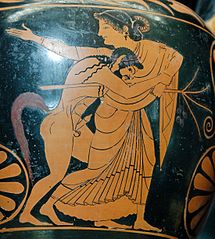
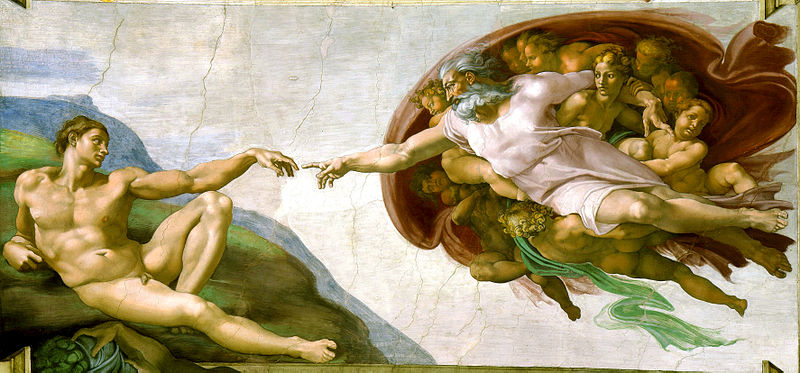
The first is from the Lascaux Cave in France, and is estimated to be about 17,300 years old.  The second was painted on a jar in Greece around 520 BC.  The third was made in Italy in 1338.  The fourth was also made in Italy in 1511.  Why do they all look so different?  Compare these to the following:


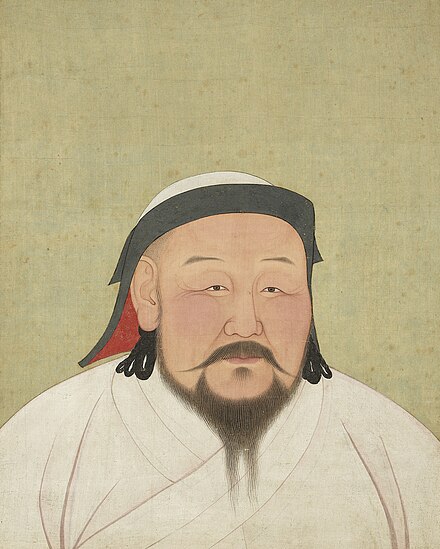
The first was painted in China in 1294.  The second was painted in Japan in 1793.  These paintings look really different from the European paintings shown above.  Why?

I'm assuming that one goal of art is representation.  None of subjects in any of these paintings really look anything like the people that you see directly with your own eyes.  Why is that?  Are these depictions supposed to convey something more than mere representation?  What else is included?